
Blog
IELTS full Mock test with band 9 answers
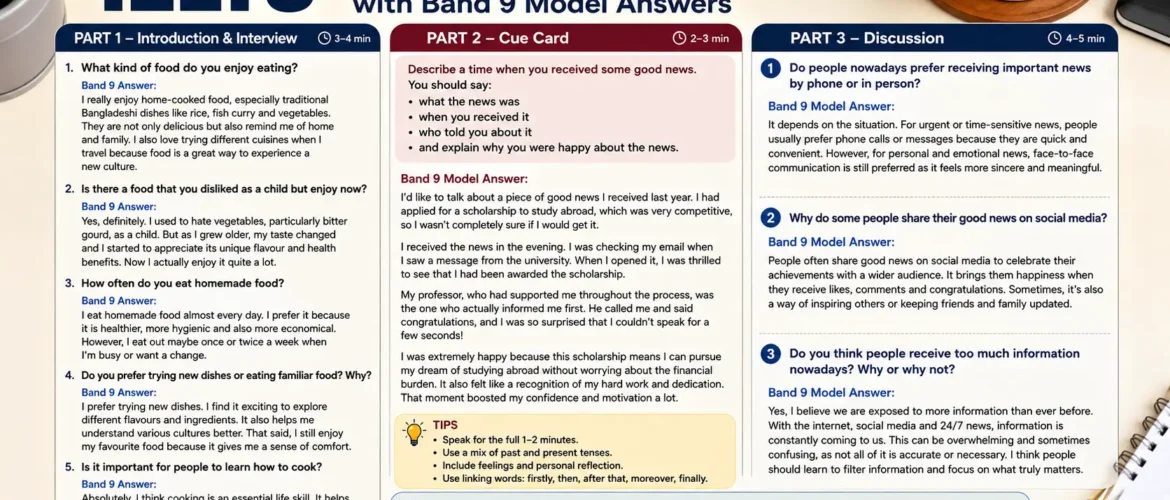
IELTS full Mock test with band 9 answers
IELTS Speaking — New Mock Test 19.08.2026
PART 1 — Food & Cooking 🍳
- What kind of food do you enjoy eating?
- Is there a food that you disliked as a child but enjoy now?
- How often do you eat homemade food?
- Do you prefer trying new dishes or eating familiar food? Why?
- Is it important for people to learn how to cook?
PART 2 — Cue Card
Describe a time when you received some good news.
You should say:
- what the news was
- when you received it
- who told you about it
- and explain why you were happy about the news
PART 3 — Good News & Communication 📱
- Do people nowadays prefer receiving important news by phone or in person?
- Why do some people share their good news on social media?
- Do you think people receive too much information nowadays? Why or why not?
IELTS Speaking Band 9 — Model Answers
Topic: Food, Cooking, Good News & Communication
Below are natural Band 9-style answers. The goal is not to use complicated words unnecessarily, but to demonstrate Fluency & Coherence, Lexical Resource, Grammatical Range & Accuracy, and Pronunciation through natural, flexible language.
PART 1 — Food & Cooking 🍳
1. What kind of food do you enjoy eating?
Band 9 Answer:
I’m quite fond of home-cooked Bengali food, particularly rice with fish, vegetables and lentils. I enjoy it because it’s both flavourful and comforting, and it reminds me of family meals. That said, I’m also quite adventurous when it comes to food, so I occasionally enjoy trying foreign cuisines, especially Thai and Italian dishes.
Useful expressions:
- I’m quite fond of… = I really like…
- flavourful and comforting
- reminds me of…
- I’m quite adventurous when it comes to…
- occasionally enjoy trying…
Bangla idea:
এখানে শুধু “I like food” না বলে specific food + reason + additional idea দেওয়া হয়েছে।
2. Is there a food that you disliked as a child but enjoy now?
Band 9 Answer:
Yes, definitely. When I was a child, I couldn’t stand bitter vegetables, particularly bitter gourd. I found the taste extremely unpleasant and would always try to avoid it. However, as I grew older, my tastes changed, and I gradually began to appreciate it. Now I actually enjoy it, especially when it is cooked with spices and served with rice.
Excellent vocabulary:
- couldn’t stand = strongly disliked
- extremely unpleasant
- avoid
- as I grew older
- my tastes changed
- gradually began to appreciate
Grammar highlight:
Notice the contrast:
When I was a child… → Now I actually enjoy it.
This gives the answer a natural past-to-present development.
3. How often do you eat homemade food?
Band 9 Answer:
I eat homemade food almost every day. In fact, I prefer it to eating out because I know exactly what ingredients are being used, and I find it much healthier and more satisfying. I might eat out once or twice a week, particularly when I’m busy or meeting friends, but home-cooked meals are definitely a staple of my diet.
Band 9 expressions:
- almost every day
- I prefer it to…
- I know exactly what ingredients are being used
- healthier and more satisfying
- a staple of my diet
Bangla:
“প্রায় প্রতিদিন” → almost every day
“খাদ্যতালিকার নিয়মিত অংশ” → a staple of my diet
4. Do you prefer trying new dishes or eating familiar food? Why?
Band 9 Answer:
I’d say a bit of both, but I tend to lean towards trying new dishes. I think food is a great way to experience different cultures, so whenever I travel, I make a point of sampling local cuisine. Having said that, when I’m tired or simply want something comforting, I usually go for a familiar dish that I know I’ll enjoy.
Excellent structure:
Direct answer → reason → example → contrast
“I’d say a bit of both…”
“I think…”
“Whenever I travel…”
“Having said that…”
This is much more natural than giving a long, memorised answer.
5. Is it important for people to learn how to cook?
Band 9 Answer:
Absolutely. I think cooking is an essential life skill, regardless of someone’s age or profession. It allows people to prepare healthier meals, save money and become less dependent on restaurants or takeaway food. More importantly, cooking can be quite therapeutic, so it can also be a good way to unwind after a stressful day.
High-level lexical resources:
- an essential life skill
- less dependent on
- takeaway food
- therapeutic
- unwind
- after a stressful day
PART 2 — CUE CARD 🎤
Describe a time when you received some good news.
Band 9 Model Answer
Well, I’d like to talk about a piece of good news that I received a few years ago when I was waiting for an important academic result.
At the time, I had just completed an examination that I had worked extremely hard for, and naturally, I was on tenterhooks because I had no idea what the outcome would be. I kept checking my phone throughout the day, although I tried to distract myself by watching television and spending time with my family.
Then, completely out of the blue, I received a phone call from one of my close friends. He told me that I had achieved an excellent result and had actually done much better than I had expected. I was over the moon. For a few seconds, I couldn’t believe what I was hearing, because I had spent weeks worrying about the result.
I immediately told my family, and they were absolutely delighted. We had a small celebration at home, and it was a really memorable moment for all of us.
What made the news particularly special was not simply the result itself, but the fact that it validated all the hard work and sacrifices I had made. It gave me a tremendous confidence boost and encouraged me to set even more ambitious goals for the future.
Looking back, I’d say it was one of those moments when all the stress and uncertainty suddenly seemed worthwhile.
🎯 Why this is Band 9 style
1. Strong opening
“Well, I’d like to talk about…”
Natural introduction rather than memorised vocabulary.
2. Storytelling
The answer follows a clear timeline:
Situation → waiting → phone call → reaction → celebration → impact
3. Strong emotional language
Instead of:
❌ “I was very happy.”
Use:
✅ I was over the moon.
✅ I was absolutely delighted.
✅ I couldn’t believe what I was hearing.
✅ It gave me a tremendous confidence boost.
4. Idioms used naturally
on tenterhooks = very anxious while waiting for something
out of the blue = unexpectedly
over the moon = extremely happy
⚠️ Don’t force 5–10 idioms into one cue card. Two or three natural idioms are enough.
PART 3 — Good News & Communication 📱
1. Do people nowadays prefer receiving important news by phone or in person?
Band 9 Answer
I think it depends on the nature of the news. For routine or time-sensitive information, people generally prefer receiving it by phone because it’s quick and convenient. However, if the news is particularly personal or emotionally significant, I think people still prefer face-to-face communication.
For example, if someone has received a job offer, they might immediately call their family and share the news. But if they have something deeply personal to discuss, a face-to-face conversation tends to feel more sincere and meaningful.
⭐ Useful expressions
- It depends on the nature of…
- routine or time-sensitive information
- quick and convenient
- emotionally significant
- face-to-face communication
- feel more sincere and meaningful
🎯 IELTS Trick
For Part 3, avoid giving only:
“Yes, I think people prefer phones.”
Instead:
Opinion → distinction → example → conclusion
2. Why do some people share their good news on social media?
Band 9 Answer
There are several reasons for this. First and foremost, social media allows people to share important milestones with a large number of people instantly. For example, someone who gets married, graduates from university or lands their dream job can inform friends and relatives with a single post.
Another reason is that people naturally seek social recognition and emotional support. When others congratulate them or leave positive comments, it can make the achievement feel even more special.
That said, I don’t think everyone shares good news simply for attention. For many people, social media is just a convenient way of keeping friends and relatives in the loop, particularly when they live far away.
⭐ Band 9 vocabulary
- important milestones
- instantly
- lands their dream job
- social recognition
- emotional support
- keep someone in the loop
- live far away
💡 Idiom
keep someone in the loop
= keep someone informed about what is happening.
3. Do you think people receive too much information nowadays?
Band 9 Answer
Yes, without a doubt. We live in an information-saturated world, where people are constantly exposed to news, social media posts, advertisements and notifications. The problem isn’t necessarily the amount of information itself, but the difficulty of distinguishing reliable information from misinformation.
For instance, someone can open their phone in the morning and immediately be bombarded with dozens of headlines and notifications. As a result, people may feel overwhelmed and find it difficult to concentrate on one thing at a time.
Personally, I think the solution is not to avoid technology altogether, but to consume information more selectively. People should verify important information, limit unnecessary notifications and occasionally take a break from social media.
⭐ Excellent lexical resources
- an information-saturated world
- constantly exposed to
- misinformation
- bombarded with
- feel overwhelmed
- concentrate on
- consume information selectively
- verify information
- limit unnecessary notifications
- take a break from social media
🔥 BAND 9 SPEAKING FORMULA
For this entire mock test, remember:
PART 1
Answer + Reason + Small Example
“Yes, I do. I enjoy… because… For example…”
PART 2
Story + Details + Feelings + Reflection
What happened → When → Who → What you felt → Why it mattered
PART 3
Opinion + Explanation + Example + Contrast/Result
“I think… The main reason is… For example… However…”
🎙️ Pronunciation, Intonation & Energy
A Band 9 speaker should not sound like they are reading an essay.
Instead of speaking like this:
“Yes. I like cooking. It is important. People should learn it.”
Use natural intonation and emphasis:
“Absolutely! I think cooking is an essential life skill, because it gives people independence and allows them to eat more healthily.”
Emphasise key words:
ABSOLUTELY → ESSENTIAL LIFE SKILL → INDEPENDENCE → HEALTHILY
Show emotion in Part 2
When talking about good news:
😊 “I was absolutely over the moon!”
When describing anxiety:
😟 “I was literally on tenterhooks.”
When describing surprise:
😮 “Completely out of the blue, I received a phone call…”
Your voice should rise and fall naturally. Don’t keep the same tone throughout the answer.
🚫 Replace Weak Expressions
| Avoid | Better |
| very happy | over the moon / absolutely delighted |
| very tired | completely exhausted |
| very important | crucial / essential |
| very interesting | fascinating / intriguing |
| very good | excellent / impressive / remarkable |
| many people | a large proportion of people / countless people |
| many things | a wide range of things |
| very difficult | extremely challenging |
| very busy | extremely hectic |
| very bad | highly problematic / detrimental |
| I like it very much | I’m particularly fond of it |
| I don’t like it | I’m not particularly fond of it |
Key rule: Don’t replace every simple word with a “Band 9” word. Precision + naturalness + flexibility are more important than difficult vocabulary.
IELTS Speaking Mock Test Evaluation
Based on the answers you provided, I would estimate the candidate at Band 7.0 overall in a real IELTS Speaking test.
The candidate has good ideas, relevant examples, a strong ability to extend answers, and some impressive vocabulary, but frequent grammatical errors, repetition, hesitation and unnatural collocations prevent the performance from reaching Band 8/9.
Estimated Score
| IELTS Criterion | Estimated Band | Main Reason |
| Fluency & Coherence | 7.0 | Generally able to speak at length, but there are pauses, repetitions and some unclear transitions |
| Lexical Resource | 7.0 | Good range: tremendously, significant, magnificent, cultural events, traditional food, etc., but several collocations are inaccurate |
| Grammatical Range & Accuracy | 6.5 | Uses complex structures, but errors with tense, articles, prepositions, subject-verb agreement and sentence construction are frequent |
| Pronunciation | 7.0 | Generally understandable and expressive; emphasis and intonation can be improved |
| Overall | 7.0 | Strong potential, but accuracy and naturalness need improvement |
PART 1 — FOOD & COOKING
Question 1
Examiner:
What kind of food do you enjoy eating?
Candidate’s Answer
“Well, that’s a very interesting question. I usually like to eat vegetables. On the other hand, I also fond of some junk food, but it really depends on occasions. For example, if I with my friend and family on an occasion or some cultural events, then I like to eat some deshi Bangladeshi food or traditional food. For example, biryani, khichuri, mutton tehari and so on.”
🎯 Estimated Band: 7.0
What was good
Fluency & Coherence — 7
- You answered immediately.
- You gave examples.
- You introduced a contrast between healthy food and junk food.
- The answer was developed rather than just one sentence.
Lexical Resource — 7
Good vocabulary:
- junk food
- cultural events
- traditional food
- biryani
- khichuri
- mutton tehari
Grammar — 6.5
There are noticeable errors:
❌ “I also fond of”
✅ “I am also fond of”
❌ “it depends on occasions”
✅ “it depends on the occasion”
❌ “if I with my friend and family”
✅ “if I am with my friends and family”
⭐ Band 9 Answer
Well, I’m particularly fond of traditional Bangladeshi cuisine, especially dishes like biryani, khichuri and mutton tehari. I do have a soft spot for junk food as well, but I tend to have it only occasionally. If I’m attending a family gathering or a cultural celebration, I’d definitely go for traditional food because it reminds me of home and gives me a real sense of comfort.
🔥 Useful expressions
- I’m particularly fond of…
- I have a soft spot for…
- I tend to…
- I’d definitely go for…
- a real sense of comfort
Question 2
Examiner:
Is there a food that you disliked as a child but enjoy now?
Candidate’s Answer
“Well, to be honest, I dislike vegetables when I was a child. But day by day, I realized that it is very important for your health. So now, as I’ve said before, it is one of my main food that I used to eat regularly.”
🎯 Estimated Band: 6.5–7.0
Main problem
The idea is good, but your tense control needs work.
❌ “I dislike vegetables when I was a child.”
Because you are talking about the past:
✅ “I disliked vegetables when I was a child.”
Also:
❌ “one of my main food”
Food is generally uncountable here.
✅ “one of the main foods in my diet.”
⭐ Band 9 Answer
Definitely. When I was a child, I couldn’t stand vegetables, particularly leafy greens. I found them rather bland and would often avoid eating them. However, as I grew older, I became much more conscious of my health and gradually developed a taste for them. These days, vegetables are actually a regular part of my diet, and I genuinely enjoy them.
🔥 Great vocabulary
- couldn’t stand
- leafy greens
- rather bland
- developed a taste for
- a regular part of my diet
- genuinely enjoy
Question 3
Examiner:
How often do you eat homemade food?
Candidate’s Answer
“Well, I usually like to eat my homemade food when I was free from my daily routine. As I’m a full-time professor and it’s very difficult for me to have my food in my house. So, this is a very tough question for me to answer, but it really happens that I have to enjoy my food of my own.”
🎯 Estimated Band: 6.5
This was one of the weaker answers.
Problems
❌ “when I was free”
You are describing your current routine.
✅ “when I am free”
❌ “have my food in my house”
Natural English:
✅ “eat at home.”
❌ “enjoy my food of my own”
Better:
✅ “prepare and eat my own meals.”
⭐ Band 9 Answer
I eat homemade food whenever my schedule allows me to. Since I’m a full-time professor, my weekdays can be quite hectic, so I don’t always have the opportunity to eat at home. However, whenever I have some time off, I much prefer a home-cooked meal because it’s healthier, more economical and, quite frankly, more satisfying than eating out.
🔥 Excellent expressions
- whenever my schedule allows me to
- my weekdays can be quite hectic
- have some time off
- home-cooked meal
- more economical
- quite frankly
Question 4
Examiner:
Do you prefer trying new dishes or eating familiar food? Why?
Candidate’s Answer
“Well, that’s a very interesting question to answer. I usually like to test some different kinds of cuisine because I’m a food lover. So, besides of familiar foods, I also like to eat some Italian food, some Chinese food, Japanese food, as well as some Mexican burger, which is one of my favorite from the last few years.”
🎯 Estimated Band: 7.0
Good development and examples.
Corrections
❌ “test some different kinds of cuisine”
✅ “try different kinds of cuisine.”
❌ “besides of familiar foods”
✅ “besides familiar foods” / “apart from familiar foods”
❌ “some Mexican burger”
Better:
✅ “Mexican burgers” / “Mexican-style food”
❌ “one of my favorite from the last few years”
✅ “one of my favourites in recent years.”
⭐ Band 9 Answer
I’d say I’m quite adventurous when it comes to food, so I generally prefer trying new dishes. I’m particularly interested in exploring different cuisines because food gives me an opportunity to experience other cultures. Apart from my usual Bengali dishes, I enjoy Italian, Chinese and Japanese cuisine, and I’ve recently developed a real liking for Mexican food as well.
🔥 Band 9 expressions
I’m quite adventurous when it comes to food.
explore different cuisines
experience other cultures
develop a real liking for…
Question 5
Examiner:
Is it important for people to learn how to cook?
Candidate’s Answer
“Yes, obviously. Because I, I think we should become independent. Suppose, a person who wants to study abroad and they are they didn’t find or they do not find their parents or their family. So, in that case, they have to prepare their food of their own. So, in that point of view, I think or I believe, it’s very important for a person to to know how to eat, sorry, how to make food of their own.”
🎯 Estimated Band: 6.5–7.0
What is good?
The idea is excellent.
You gave a practical example:
studying abroad → parents unavailable → need to cook → independence
That’s exactly the type of development IELTS likes.
But there is too much self-correction and grammatical instability.
⭐ Band 9 Answer
Absolutely. I think cooking is an essential life skill because it allows people to become more self-reliant. For example, if someone moves abroad for higher education, they may no longer have their parents around to prepare meals for them. In that situation, knowing how to cook can save them money, help them maintain a healthy diet and, most importantly, give them a greater sense of independence.
🔥 Excellent vocabulary
- an essential life skill
- self-reliant
- move abroad
- higher education
- maintain a healthy diet
- a greater sense of independence
PART 2 — CUE CARD
Describe a time when you received some good news.
Candidate’s Answer
Your cue-card answer was actually one of the strongest parts of the test.
🎯 Estimated Band: 7.5
Why?
You included:
✅ What the news was
✅ When you received it
✅ Who told you
✅ Why it was important
✅ Personal background
✅ A teacher/mentor
✅ Emotional reaction
✅ Reflection on its impact
That is excellent content development.
Candidate’s Answer — Key Strengths
You said:
“It was my first job in a public university.”
Excellent — this gives the story a clear focus.
You also explained:
“My father was a school teacher and I have inspired from him a lot since my childhood.”
This is useful because it explains why the news was meaningful, rather than merely saying you were happy.
You also introduced your professor:
“He is one of my mentor…”
That made the story personal and memorable.
And this was a good emotional statement:
“I couldn’t express how much important that job was at that time.”
The idea is strong, although the grammar needs correction.
⭐ Band 9 Cue Card Answer
Well, I’d like to talk about a piece of good news that I received about two years ago, when I was offered a position as an assistant professor at a public university.
I remember the moment vividly because becoming a university teacher had been a long-standing ambition of mine. My father was a school teacher, and while growing up, I was deeply inspired by the way he found fulfilment in educating and helping other people. So, becoming a teacher myself was something I had genuinely aspired to since childhood.
What made the news even more special was the fact that I was appointed to the very university where I had completed both my undergraduate and postgraduate studies. It felt incredibly rewarding to return to the place where I had once been a student, but this time as a member of the teaching staff.
I was actually informed by one of my former professors, who had been a great mentor to me. He had once told me that I had the qualities needed to become a good teacher and encouraged me to work hard towards that goal. So, when he told me that I had got the job, I was absolutely over the moon. For a moment, I was genuinely speechless.
What made that piece of news particularly meaningful was that it felt like the culmination of years of hard work, encouragement and perseverance. It gave me an enormous confidence boost and reinforced my belief that if you remain committed to your goals, your efforts can eventually pay off.
🔥 Why the Band 9 Answer is Better
Instead of:
❌ “one of my first job”
Use:
✅ “one of my most significant career achievements”
Instead of:
❌ “I have inspired from him”
Use:
✅ “I was deeply inspired by him.”
Instead of:
❌ “very important for me”
Use:
✅ “particularly meaningful to me”
Instead of:
❌ “I was totally mesmerized”
Use:
✅ “I was absolutely over the moon.”
⚠️ “Mesmerized” is not the best word for receiving good news. It usually means being fascinated or captivated by something.
PART 3 — QUESTION 1
Examiner:
Do you think people nowadays prefer receiving important news by phone or in person?
Candidate’s Answer
“Well, it really depends. From If I want to talk about generation. We play like to receive good news in person. But nowadays, as technology have advanced a lot, people like to receive the good news by mobile phone instead of in person. So I believe, it depends, person to person.”
🎯 Estimated Band: 6.5
Main problems
❌ “From if I want to talk about generation”
❌ “We play like to receive”
❌ “technology have advanced”
✅ “technology has advanced”
❌ “depends, person to person”
✅ “varies from person to person.”
The idea is good, but the delivery is fragmented.
⭐ Band 9 Answer
I think it largely depends on the nature of the news. For routine or time-sensitive information, people tend to prefer receiving it by phone because it’s quick and convenient. However, when the news is particularly personal or emotionally significant, I think face-to-face communication is still preferable because it feels more sincere and allows people to share the moment together. So, overall, I’d say the preferred method varies from person to person and depends largely on the circumstances.
🔥 Part 3 structure
Opinion → Reason → Contrast → Conclusion
This is an excellent structure for Band 8/9.
PART 3 — QUESTION 2
Examiner:
Why do some people share their good news on social media?
Candidate’s Answer
“Well, in my opinion, this is because nowadays people like to share their good news with the world. And social media is the main, we can say, main platform from where we can able to receive a good news within a moment. This is a positive environment or this is a positive impact for socialisam or so, or you can say, the social community as well. In that way, we can able to connect each other. And it’s a positive change I believe.”
🎯 Estimated Band: 6.5–7.0
Good points
You understood the question and gave a clear reason:
social media → share news → connect with others
But you repeated:
“main… main platform”
“we can able to…”
“positive… positive…”
These repetitions affect fluency.
⭐ Band 9 Answer
**There are several reasons why people do this. First and foremost, social media allows them to share important milestones with a large number of people almost instantly. For example, if someone graduates, gets married or lands their dream job, they can share the news with friends and relatives through a single post.
Another reason is that people naturally seek recognition and emotional support. Receiving congratulatory messages and positive comments can make an achievement feel even more special. In addition, social media is a convenient way of keeping people in the loop, particularly when close friends or relatives live far away.**
🔥 Excellent vocabulary
- important milestones
- almost instantly
- lands their dream job
- seek recognition
- emotional support
- congratulatory messages
- keep people in the loop
PART 3 — QUESTION 3
Examiner:
Do you think people receive too much information nowadays? Why or why not?
Candidate’s Answer
“Well, to be honest, as I have said before, the social media have tremendously changed our life. From the past couple of years. So, we can able to receive any sort of information by clicking, by by simple click to the social media. So, in that case, I think nowadays we are receiving lots of news via social media. But it have both impacts. It can be positive or negative. Too much information can make our life frustrated. And it is also important to stay updated. Because the world is moving so fast. So, without updating ourselves, it’s totally impossible for moving forward.”
🎯 Estimated Band: 7.0
This answer has a good Part 3 idea because you considered both sides.
Good:
“It can be positive or negative.”
“It is also important to stay updated.”
That’s a balanced answer.
Grammar corrections
❌ “social media have tremendously changed”
✅ “social media has tremendously changed”
❌ “From the past couple of years.”
✅ “Over the past couple of years.”
❌ “we can able to receive”
✅ “we are able to receive”
❌ “by simple click”
✅ “with a simple click”
❌ “it have both impacts”
✅ “it has both positive and negative effects.”
❌ “make our life frustrated”
✅ “make people feel overwhelmed.”
⭐ Band 9 Answer
**Yes, without a doubt. We live in an information-saturated world, and people are constantly exposed to news, social media posts, advertisements and notifications. With just a few taps on a smartphone, we can access an enormous amount of information within seconds.
The problem, however, isn’t simply the quantity of information; it’s the difficulty of distinguishing reliable information from misinformation. People can easily become overwhelmed, particularly when they are bombarded with conflicting headlines and opinions.
That said, staying informed is still essential in today’s fast-changing world. So, rather than avoiding information altogether, I think people need to become more selective about what they consume and learn to verify information before accepting it as fact.**
📊 FINAL PERFORMANCE ANALYSIS
1. Fluency & Coherence — 7.0
Strengths
You can:
- speak at length
- develop ideas
- provide examples
- tell a personal story
- explain opinions
- compare two sides
Main weaknesses
You frequently use fillers:
“Well…”
“So…”
“I think…”
“as I have said before…”
“you can say…”
And sometimes restart sentences:
“by by simple click…”
“the main, we can say, main platform…”
🎯 Improvement
Don’t try to eliminate every pause.
Instead of:
“Well… um… I think… so… actually…”
Use controlled thinking phrases:
“That’s an interesting question.”
“I’d say it depends on…”
“There are a couple of reasons for this.”
“From my perspective…”
“Having said that…”
2. Lexical Resource — 7.0
You already have some strong vocabulary:
- tremendously
- significant
- magnificent
- cultural events
- traditional food
- social media
- positive impact
- public university
- mentor
- contributions
But the problem is collocation.
For example:
❌ “magnificent moment”
Better:
✅ “a deeply meaningful moment”
❌ “positive environment for socialism”
Better:
✅ “a positive way of strengthening social connections”
❌ “test different cuisine”
Better:
✅ “try different cuisines”
❌ “make food of their own”
Better:
✅ “prepare their own meals”
3. Grammatical Range & Accuracy — 6.5
This is your biggest area for improvement.
Your recurring errors:
Subject-verb agreement
❌ “technology have advanced”
✅ “technology has advanced”
Tense
❌ “I dislike vegetables when I was a child.”
✅ “I disliked vegetables when I was a child.”
Articles
❌ “I got job”
✅ “I got a job”
Prepositions
❌ “depends on person to person”
✅ “varies from person to person”
Verb patterns
❌ “I am inspired from him”
✅ “I was inspired by him.”
4. Pronunciation — 7.0
From the transcript, the candidate appears to have generally understandable speech, but the performance would benefit from stronger sentence stress, rhythm and intonation.
Don’t speak every word with equal emphasis.
Instead:
I was ABSOLUTELY over the MOON when I received the NEWS.
And:
The problem isn’t simply the QUANTITY of information; it’s the DIFFICULTY of distinguishing reliable information from misinformation.
This creates natural IELTS Speaking rhythm.
🏆 FINAL ESTIMATED BAND: 7.0
Potential: 8.0+
The candidate already has the ideas and communication ability needed for a higher score. The biggest barrier is grammatical accuracy + natural collocations + reducing repetition.
Priority order for improvement:
1️⃣ Grammar accuracy
↓
2️⃣ Natural collocations
↓
3️⃣ Reduce fillers/repetition
↓
4️⃣ Improve intonation and emphasis
↓
5️⃣ Add sophisticated vocabulary naturally
The key lesson is: Don’t try to sound “Band 9” by using difficult words everywhere. Sound natural, precise, flexible and confident.
For Admission: 01773744422
#manchesterenglishacademy #ielts #ieltsmocktest #ieltsspeakingmocktest