Blog
🎤 IELTS Speaking — NEW Full Mock Test: Part 1 (Reading & Books), Part 2 (Cue Card: Describe a useful skill you learned outside school or university), Part 3 (Skills & Education)
Manchester English Academy Bangladesh
🎤 IELTS Speaking — NEW Full Mock Test: Part 1 (Reading & Books), Part 2 (Cue Card: Describe a useful skill you learned outside school or university), Part 3 (Skills & Education)
IELTS Speaking — NEW Full Mock Test
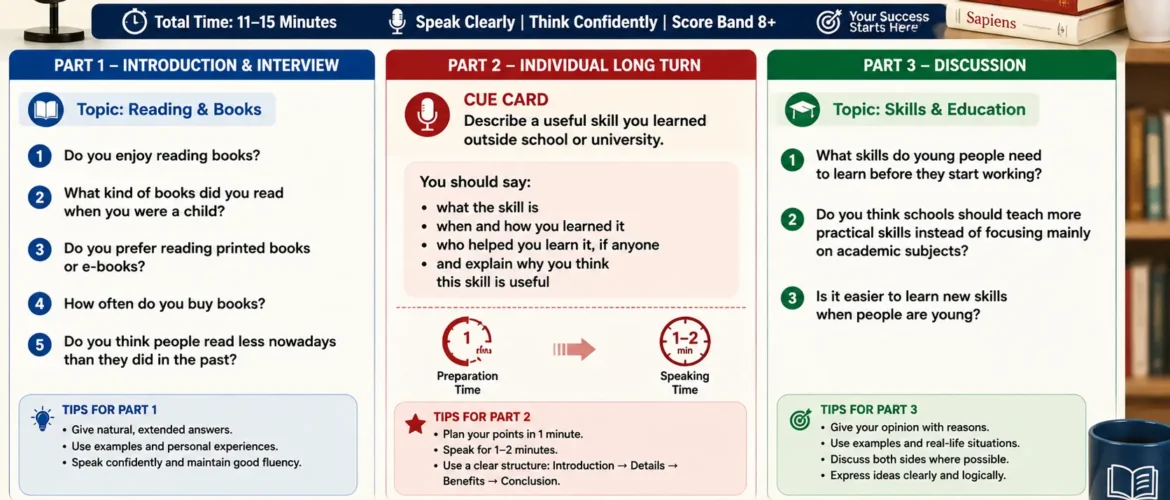
⏱️ 11–15 Minutes | Fresh Topics
I’ve deliberately avoided the topics you have recently practised, such as food, holidays, business, work, hometown, cars, good news, and television.
PART 1 — Reading & Books 📚
1. Do you enjoy reading books?
2. What kind of books did you read when you were a child?
3. Do you prefer reading printed books or e-books?
4. How often do you buy books?
5. Do you think people read less nowadays than they did in the past?
PART 2 — Cue Card 🎤
Describe a useful skill you learned outside school or university.
You should say:
- what the skill is
- when and how you learned it
- who helped you learn it, if anyone
- and explain why you think this skill is useful
Examiner:
“You have one minute to prepare your answer. You may make some notes if you wish.”
After one minute:
“Alright, you can start speaking now.”
PART 3 — Skills & Education 🎓
1. What skills do young people need to learn before they start working?
2. Do you think schools should teach more practical skills instead of focusing mainly on academic subjects?
3. Is it easier to learn new skills when people are young?
🎯 What to focus on in this mock
While answering, try to demonstrate:
1. Fluency
Don’t stop after one sentence.
❌ “Yes, I like reading because it is interesting.”
✅ “Yes, absolutely. I’ve always been quite fond of reading, particularly books that allow me to explore new ideas. Whenever I have some downtime, I usually pick up a book rather than scrolling through social media.”
2. Natural vocabulary
Instead of repeating very, very, very, use stronger expressions:
- extremely useful
- highly beneficial
- particularly valuable
- a rewarding experience
- a practical skill
- a lifelong skill
- broaden my horizons
- expand my knowledge
- learn through trial and error
- put something into practice
3. Idiomatic language
Use idioms naturally—not mechanically.
- broaden my horizons → নতুন জ্ঞান ও অভিজ্ঞতার দিগন্ত প্রসারিত করা
- a steep learning curve → শুরুতে শেখা কঠিন হওয়া
- get the hang of something → কোনো কিছু ধীরে ধীরে আয়ত্ত করা
- learn the ropes → কাজের মূল বিষয়গুলো শেখা
- practice makes perfect → অনুশীলনেই দক্ষতা আসে
4. Complex grammar
Try structures such as:
Although + clause, + clause
If + past, would + verb
Not only + auxiliary + subject + verb, but…
Example:
“Although I initially found the skill quite challenging, I gradually got the hang of it through regular practice.”
5. Emotion + intonation
Don’t speak like you are reading a script. Show enthusiasm when discussing something you genuinely like, and use a more thoughtful tone when giving an opinion.
Target: natural, confident, energetic Band 8–9 delivery.
IELTS Speaking — Band 9 Model Answers
NEW Mock Test: Reading, Useful Skills & Education
Below are natural Band 9-style answers. They are designed to sound like a strong candidate speaking spontaneously—not like memorised essays.
PART 1 — READING & BOOKS 📚
1. Do you enjoy reading books?
Band 9 Answer:
Absolutely. I’m quite an avid reader, although the amount I read depends on how busy I am. I particularly enjoy books about psychology, history and personal development because they give me new perspectives on life. I usually read for about 20 or 30 minutes before going to bed, as I find it relaxing and intellectually stimulating.
Useful expressions:
- an avid reader = একজন আগ্রহী পাঠক
- new perspectives on life = জীবনের নতুন দৃষ্টিভঙ্গি
- intellectually stimulating = বুদ্ধিবৃত্তিকভাবে উদ্দীপনামূলক
- wind down = মানসিকভাবে আরাম করা
Tip:
Don’t simply say “Yes, I like reading.” Give answer + reason + example/habit.
2. What kind of books did you read when you were a child?
Band 9 Answer:
When I was a child, I was particularly interested in adventure stories and fairy tales. I loved stories that had exciting plots and imaginative characters because they allowed me to escape into a completely different world. I also read quite a few illustrated storybooks, which probably played a role in developing my imagination.
Strong vocabulary:
- adventure stories
- imaginative characters
- escape into another world
- illustrated storybooks
- develop my imagination
Tip:
For childhood questions, use past tense naturally:
“When I was a child, I used to…”
This immediately shows grammatical range.
3. Do you prefer reading printed books or e-books?
Band 9 Answer:
Personally, I prefer printed books, mainly because I enjoy the physical experience of reading. There is something satisfying about turning the pages, highlighting important passages and actually seeing my progress through a book. That said, I do use e-books when I’m travelling because they are far more convenient and I can carry dozens of books on a single device.
Excellent contrast:
Personally, I prefer… That said, …
This is a very natural way to give a balanced answer.
Useful phrase:
the best of both worlds
Example:
“Ideally, I’d like to have the best of both worlds—printed books at home and e-books when I travel.”
4. How often do you buy books?
Band 9 Answer:
I don’t buy books on a fixed schedule, but I probably purchase one or two every couple of months. I tend to buy a book when someone recommends something particularly interesting or when I come across a title related to something I’m currently studying. I also sometimes buy books as gifts for friends or family members.
Tip:
Don’t force an idiom into every answer. Band 9 is about natural and precise language, not using as many idioms as possible.
5. Do you think people read less nowadays than they did in the past?
Band 9 Answer:
Yes, to some extent, I think they do, particularly when it comes to long-form reading. People nowadays are surrounded by short videos, social media posts and other forms of instant entertainment, so their attention spans may be shorter than before. However, I wouldn’t say that people have stopped reading altogether. In fact, many people consume a huge amount of written content online; the main difference is probably the format and the amount of time they spend on it.
Excellent Band 9 structure:
Opinion → Reason → Explanation → Contrast
“Yes, to some extent…”
“However, I wouldn’t say…”
This makes the answer nuanced rather than overly absolute.
PART 2 — CUE CARD 🎤
Describe a useful skill you learned outside school or university.
Band 9 Sample Answer
Well, I’d like to talk about public speaking, which is probably one of the most useful skills I’ve learned outside formal education.
I started developing this skill a few years ago when I realised that having knowledge wasn’t enough; I also needed to be able to communicate my ideas clearly and confidently. Initially, I was quite nervous whenever I had to speak in front of a group of people. I would sometimes forget what I wanted to say, speak too quickly and worry excessively about making mistakes.
To overcome this, I started practising regularly. I watched experienced speakers, recorded myself speaking and then listened to the recordings to identify my weaknesses. I also tried to speak in front of small groups of friends and gradually increased the size of the audience. So, in a sense, I learned through trial and error.
The biggest improvement came when I stopped trying to sound perfect and started focusing on communicating my message effectively. I learned how to organise my ideas, use appropriate body language, control my voice and maintain eye contact.
I consider this skill extremely useful because it has helped me in both my personal and professional life. Whether I’m giving a presentation, participating in a meeting or simply explaining an idea to someone, I’m now much more confident.
Looking back, I’d say learning public speaking was a turning point for me. It didn’t just improve my communication skills; it also boosted my confidence and helped me become much more comfortable expressing my opinions.
So, although it was quite challenging at first, I would definitely describe it as a lifelong skill that continues to benefit me.
🔥 Why this can score Band 8/9
Fluency & Coherence
The answer has a clear progression:
Skill → When → Problem → Learning process → Improvement → Benefits → Reflection
Lexical Resource
Excellent expressions:
- formal education
- communicate my ideas clearly
- speak in front of a group
- overcome this
- trial and error
- identify my weaknesses
- organise my ideas
- appropriate body language
- maintain eye contact
- a turning point
- boost my confidence
- a lifelong skill
Grammar
Notice the variety:
“When I realised that having knowledge wasn’t enough…”
“I would sometimes forget what I wanted to say…”
“If I had to describe its impact…”
“Although it was quite challenging at first…”
Intonation & Emotion 🎙️
Don’t deliver the cue card in one flat voice.
For example:
“Initially, I was quite nervous…”
Say this more slowly and thoughtfully.
Then increase your energy:
“But the biggest improvement came when I stopped trying to sound perfect…”
And finish confidently:
“It continues to benefit me.”
PART 3 — SKILLS & EDUCATION
1. What skills do young people need to learn before they start working?
Band 9 Answer
I think young people need a combination of technical skills and soft skills before entering the workplace. Obviously, they need job-specific knowledge, but communication, teamwork, time management and problem-solving are equally important.
For example, someone may have excellent academic qualifications, but if they can’t communicate effectively with colleagues or manage deadlines, they may struggle in a professional environment.
I’d also argue that young people should develop basic financial literacy and digital skills. These are increasingly important in modern workplaces. So, rather than focusing exclusively on academic knowledge, education systems should prepare students for the practical realities of working life.
Band 9 expressions:
- technical skills
- soft skills
- job-specific knowledge
- manage deadlines
- professional environment
- financial literacy
- digital skills
- practical realities of working life
🎯 Tip
For Part 3, don’t answer like Part 1.
❌ Too short:
“They need communication skills because communication is important.”
✅ Band 9 style:
Point → Explanation → Example → Wider result
2. Do you think schools should teach more practical skills instead of focusing mainly on academic subjects?
Band 9 Answer
Yes, to a certain extent. I don’t think academic subjects should be abandoned, because they provide students with essential knowledge and analytical abilities. However, schools could certainly place greater emphasis on practical skills that students will use in their everyday lives.
For instance, students could learn basic financial management, cooking, first aid, public speaking and even how to prepare for a job interview. These skills may not appear in traditional examinations, but they can be invaluable once students become independent adults.
Ideally, I think schools should strike a balance between theoretical knowledge and practical education. Academic learning teaches students how to think, whereas practical education can teach them how to apply what they know.
🔥 Excellent sentence
“Academic learning teaches students how to think, whereas practical education teaches them how to apply what they know.”
This is the type of clear comparison that works extremely well in Part 3.
3. Is it easier to learn new skills when people are young?
Band 9 Answer
Generally speaking, yes, but I wouldn’t say that age is the only determining factor. Young people often have more time, fewer responsibilities and greater exposure to new ideas, so they may be able to acquire certain skills more quickly.
For example, children tend to pick up languages remarkably quickly because they are constantly exposed to new vocabulary and sounds. Adults, on the other hand, may have less free time because of work and family responsibilities.
That said, adults often have advantages of their own. They tend to have more discipline, life experience and a clearer understanding of why they want to learn something. So, while young people may have an advantage in terms of flexibility and time, adults can compensate through motivation and consistency.
Ultimately, I think motivation matters more than age. If someone is genuinely determined to learn a skill, they can make substantial progress regardless of how old they are.
⭐ High-Scoring Expressions From This Mock
Instead of “very good”
Use:
- highly beneficial
- extremely valuable
- particularly useful
- remarkably effective
- immensely rewarding
Instead of “many”
Use:
- a wide range of
- a considerable number of
- a growing number of
- a substantial amount of
- countless
Instead of “very difficult”
Use:
- challenging
- demanding
- mentally taxing
- quite challenging at first
Instead of “very important”
Use:
- essential
- crucial
- vital
- of considerable importance
- indispensable
🧠 Band 9 Formula
For Part 1:
Direct answer + Reason + Example/Detail
For Part 2:
Introduction → Background → Main story → Details → Feelings → Why important → Reflection
For Part 3:
Opinion → Explanation → Example → Contrast/Result
And remember:
Don’t try to sound complicated. Try to sound natural, precise, flexible and confident.
A Band 9 speaker doesn’t use an idiom in every sentence. They use the right vocabulary at the right moment, maintain fluent development, vary their grammar, and express ideas with confidence and natural intonation.
IELTS Speaking Full Mock Test Evaluation
Based on the candidate’s actual answers in this mock test, I would estimate the performance at around Band 6.0 overall. The candidate has good ideas and tries to use advanced vocabulary, but frequent grammatical errors, unnatural collocations, repetition, and misuse of expressions prevent the answers from reaching Band 7+.
Important: Pronunciation cannot be reliably scored from a written transcript. I can assess it only from the actual audio. So the pronunciation score below is provisional.
1. Overall IELTS Speaking Band Assessment
| Criterion | Estimated Band | Main Reason |
| Fluency & Coherence | 6.0 | Generally answers the questions and develops ideas, but hesitates, repeats, and sometimes loses control of the sentence. |
| Lexical Resource | 6.0 | Good attempts at advanced vocabulary, but several words/collocations are used unnaturally. |
| Grammatical Range & Accuracy | 5.5–6.0 | Uses different structures, but there are frequent errors with tense, articles, plurals, subject–verb agreement and word forms. |
| Pronunciation | 6.0–6.5* | Cannot be accurately judged from text. If pronunciation, stress and intonation were clear, this could be higher. |
| Estimated Overall | 6.0 | Good potential, but accuracy and naturalness need substantial improvement. |
🎯 Target: Band 8–9
The biggest change needed is not simply using more difficult vocabulary.
The candidate needs to sound natural, precise, confident and controlled.
For example:
❌ “Technology has becoming more important.”
✅ “Technology has become increasingly important.”
❌ “People like to do something else rather than reading book.”
✅ “People tend to engage in other forms of entertainment rather than reading books.”
❌ “This will let off steam for my busy work.”
✅ “This skill will help me relieve the pressure associated with my demanding workload.”
PART 1 — READING & BOOKS
Question 1
Examiner:
Do you enjoy reading books?
Candidate’s Answer
“Yes, I enjoy reading books. And specially, it calls, it is one of my childhood hobbies. There are lots of reasons behind that. When I was a child, my father used to read books and since then, it became one of my great hobbies. And I love to read the novels of different literatures and different world-renowned personalities, as well as some animated movies, novels as well.”
Estimated Band: 6.0
What was good
- Clear answer: Yes
- Personal background was provided.
- The candidate gave a reason involving his father.
- He attempted some higher-level vocabulary.
Problems
❌ “it calls”
❌ “one of my childhood hobbies” → possible, but childhood hobbies sounds more natural here.
❌ “novels of different literatures”
❌ “animated movies, novels” → unclear connection.
Band 9 Answer
Yes, absolutely. Reading has been one of my favourite hobbies since childhood. My father was an avid reader, so I grew up surrounded by books, and that naturally sparked my interest in reading. I particularly enjoy novels, biographies and books written by influential people because they allow me to explore different perspectives and broaden my understanding of the world.
🔑 Band 9 Tricks
Formula:
Direct answer → Personal reason → Development → Example
Yes, absolutely → since childhood → influenced by my father → novels/biographies → broaden my understanding.
Useful expressions
- an avid reader = someone who reads a lot
- spark my interest = create an interest
- grow up surrounded by
- broaden my horizons
- gain a different perspective
- be fascinated by
- expand my knowledge
Question 2
Examiner:
What kind of books did you read when you were a child?
Candidate’s Answer
“Well, when I was a child, I used to read some books which is related to the real scenario of people’s life. For example, I love to read a book which is known as The Secret. This is one of my favorite books because it is related to the way we think and it changes our views and it’s about positivity. That’s the main book, both I used to read when I was a child.”
Estimated Band: 5.5–6.0
Main problems
❌ “books which is related” → books which were related
❌ “real scenario of people’s life” → unnatural
❌ “I love to read” when talking about childhood → I loved reading
❌ Repetition of book
Band 9 Answer
When I was a child, I was particularly drawn to books based on real-life experiences and personal development. One book I remember reading was The Secret, which had a strong influence on the way I thought about life. I found its emphasis on positivity and mindset particularly fascinating, and although I was quite young at the time, some of its ideas stayed with me.
🔑 Excellent vocabulary
- be drawn to something
- real-life experiences
- personal development
- have a strong influence on
- emphasis on
- mindset
- stay with me
Question 3
Examiner:
Do you prefer reading printed books or e-books?
Candidate’s Answer
“Well, when I was a child, I used to read printed books because at that time, there was no e-book. And for that reason, I have to buy books from the bookshops. But nowadays, there are lots of e-books are available and this is very convenient from my point of view. And I also like to read e-books because it’s very easy to get when I am needed and it’s very convenient for me.”
Estimated Band: 6.0
Problems
❌ “there are lots of e-books are available”
❌ “I have to buy” → I had to buy
❌ “easy to get when I am needed”
Band 9 Answer
These days, I would probably opt for e-books, mainly because they are incredibly convenient. I can carry hundreds of titles on a single device and access them whenever I have some spare time. That said, I still have a soft spot for printed books because there is something quite satisfying about turning the pages and physically owning a book.
🔥 Great Band 9 expressions
- opt for
- incredibly convenient
- have access to
- spare time
- have a soft spot for
- there is something satisfying about…
Question 4
Examiner:
How often do you buy books?
Candidate’s Answer
“Well, when I was a university student, I usually buy books once in every month. But nowadays, it was a very tough situation for me because I was, I’m busy at my professional life and for that reason, I don’t have the chance to buy books. But I usually like to buy book once in a year at that time.”
Estimated Band: 5.5–6.0
Problems
❌ “I usually buy” → I usually bought
❌ “once in every month” → once a month
❌ “it was a very tough situation” → inappropriate meaning
❌ “busy at my professional life” → busy with my professional life
Band 9 Answer
I used to buy books quite regularly when I was at university—probably once or twice a month. These days, however, my schedule is considerably more demanding, so I don’t have as much time to browse bookstores. As a result, I tend to buy books only a few times a year, although I still purchase them whenever I come across something particularly interesting.
Useful structures
Past habit:
I used to…
Present contrast:
These days, however,…
Result:
As a result,…
Exception:
although I still…
This creates excellent cohesion.
Question 5
Examiner:
Do you think people read less nowadays than they did in the past?
Candidate’s Answer
“Well, it really depends. In the past, there was nothing important by reading a book and it was a significant part of people’s life. But nowadays, lots of amenities are available and for that reason, people like to do something else rather than reading book. And this gives them motivated and also gives them strong enough to build their career. So, yes, it’s really decreasing day by day.”
Estimated Band: 5.5
Main problems
There are several unnatural expressions:
❌ “there was nothing important by reading a book”
❌ “lots of amenities are available”
❌ “this gives them motivated”
❌ “gives them strong enough”
Band 9 Answer
Yes, to some extent, I think people read fewer books nowadays, particularly in their leisure time. The main reason is that people have countless alternatives, such as social media, streaming platforms and online games, which can be more immediately engaging. However, I don’t think reading is disappearing altogether. Many people are simply changing the way they read, with e-books, audiobooks and online articles becoming increasingly popular.
🔥 Band 9 strategy
Don’t give an extreme answer.
Instead:
Yes, to some extent…
Then:
Reason → Examples → Qualification/contrast
This makes your answer more sophisticated.
Question 6
Examiner:
What type of books would you like to read in the future?
Candidate’s Answer
“Well, to be honest, I do not think about this. But if I want to tell about the book that I really want to read in future, then it will be my religion books. Because I feel we should become more religious in future. And if I want books, then it will be the lifestyle of our Prophet Muhammad sallallahu alaihi wa sallam. Because he is the role model of our religion.”
Estimated Band: 6.0
Band 9 Answer
In the future, I’d particularly like to read more books on spirituality, religious history and the lives of influential religious figures. I’ve always been interested in understanding how great spiritual leaders shaped their communities and inspired people. I think those books could help me reflect on my own values and develop a more balanced perspective on life.
Better lexical choices
Instead of:
❌ religion books
Say:
✅ religious books
✅ books on spirituality
✅ religious history
✅ the lives of religious figures
Question 7
Examiner:
In the future, do you think young people will read fewer books or more books?
Candidate’s Answer
“Well, that’s a difficult question to answer. But I think technology has become revolutionized. And for that reason, people are more involved themselves in technology rather than reading books. There are some sorts of social activities they are doing now. And with that, they are likely to charge their batteries. And this fuels them to detox their mind. So, I believe it will decrease day by day. And in the future, they will not like to read much books as nowadays we are reading.”
Estimated Band: 5.5–6.0
Problems
❌ “technology has become revolutionized”
❌ “involved themselves in technology”
❌ “charge their batteries” — possible idiom, but wrong context here.
❌ “detox their mind” — unnatural in this context.
❌ “much books” → many books
Band 9 Answer
I suspect young people may read fewer traditional books in the future, although I don’t think reading itself will decline. Technology is changing the way people consume written content, so younger generations may increasingly turn to e-books, audiobooks and short-form digital content. Having said that, I think quality reading will remain important because it develops concentration, critical thinking and communication skills.
🎯 Fantastic Band 9 technique
Use:
I suspect…
although…
Having said that…
This demonstrates flexibility and nuanced thinking.
PART 2 — CUE CARD
Cue Card:
Describe a useful skill you learned outside school or university.
Candidate’s Answer — Estimated Band: 6.0
There are good ideas here, but the answer contains many grammatical and lexical problems.
Strong points
✅ Clear skill: computer skills
✅ Personal background
✅ Explanation of why the skill was necessary
✅ Connection to career
✅ Future benefits
Problems
❌ “I am a background of biological science students.”
❌ “I do not have much time to acquire my skill on computer.”
❌ “technology has becoming more important”
❌ “there are some research which are conducting”
❌ “I want connect my research”
❌ “let off steam for my busy work”
The candidate has good content but weak grammatical control.
🌟 BAND 9 MODEL ANSWER
Well, there are several useful skills I’ve picked up over the years, but if I had to single out one, I’d definitely choose computer skills.
I developed this skill when I was a university student. My academic background was in biological science, so initially I didn’t have much exposure to computing. However, one of my courses, bioinformatics, made me realise how closely modern biological research is connected with technology.
At first, I learned the basics through online tutorials and by practising in my spare time. Gradually, I became more comfortable using different software and analysing research data. What started as a necessity eventually became something I genuinely enjoyed learning.
The main reason I consider this skill so useful is that it has made my academic and professional life considerably easier. Nowadays, I can analyse information more efficiently, conduct research more effectively and present my findings in a much more organised way.
Looking ahead, I believe this skill will be invaluable to my career because technology is becoming increasingly important in almost every field. So, although I originally learned computing simply because I needed it for my studies, it has turned out to be one of the most practical and valuable skills I’ve ever acquired.
🔥 Why this can reach Band 9
Fluency & Coherence
The answer follows a natural story:
Skill → When → Why → How → Development → Benefits → Future
Lexical Resource
Excellent phrases:
- pick up a skill
- single out
- academic background
- exposure to
- make me realise
- in my spare time
- gradually became more comfortable
- started as a necessity
- turned out to be
- invaluable to my career
Grammar
Notice the variety:
I developed…
I didn’t have…
made me realise…
What started as… eventually became…
I believe this skill will be…
Although I originally learned…
That is much stronger than repeatedly using:
“It is…”
“It will…”
“I think…”
PART 3
Question 1
Examiner:
What skills do young people need to learn before they start working?
Candidate’s Answer
“Well, that’s a very interesting question. On my perspective, I believe young people need to learn computer skills before going to their job market. Because nowadays, it is one of the main media for every job sectors. Without having the knowledge of computer, it’s very difficult for them to survive with the world. And it is becoming a daily scenario of our job life. So, I believe this is the only skill which need to learn before going a job market.”
Estimated Band: 6.0
Main issue
The candidate says computer skills are the only skill.
That makes the answer less sophisticated.
Band 9 Answer
I think young people need a combination of technical and interpersonal skills before entering the job market. Digital literacy is certainly essential because most modern workplaces rely heavily on technology. However, communication, teamwork, problem-solving and time management are equally important. In fact, an employee might have excellent technical knowledge, but without the ability to communicate effectively or collaborate with colleagues, it can be difficult to succeed professionally.
🔑 Band 9 trick
Avoid:
“This is the only skill.”
Use:
“I think they need a combination of…”
This gives you room to develop multiple ideas.
Question 2
Examiner:
Do you think schools should teach more practical skills instead of focusing mainly on academic subjects?
Candidate’s Answer
“Yes, definitely. Because practical knowledge is the main knowledge by whom a student become confident. And this is a fascinating thing. If a student can have the chance to learn the practical skills, besides their theoretical knowledge. And I feel, this will be the mesmerizing moment for teachers as well. If they have the chance to learn something new from the outer activities and as well as also able to teach the students with the skills. And I believe it will be a rewarding moment for them.”
Estimated Band: 5.5–6.0
Major vocabulary problem
The candidate uses:
❌ fascinating thing
❌ mesmerizing moment
❌ rewarding moment
These are not necessarily wrong individually, but they are not appropriate for the ideas being expressed.
Band 9 Answer
Yes, to a certain extent. I think schools should place greater emphasis on practical skills, but I wouldn’t suggest replacing academic subjects altogether. Academic knowledge provides students with a solid theoretical foundation, whereas practical activities teach them how to apply that knowledge in real-life situations. For example, students could learn financial literacy, communication, basic technology and problem-solving alongside traditional subjects. That combination would probably prepare them much better for university and employment.
🔥 Excellent expressions
- to a certain extent
- place greater emphasis on
- replace something altogether
- theoretical foundation
- apply knowledge in real-life situations
- alongside traditional subjects
- prepare someone for
Question 3
Examiner:
Is it easier to learn new skills when people are young?
Candidate’s Answer
“Yes, definitely. When people are young, it is very easy for them to learn new things. Rather than an old person. Because at that moment, their brain are sharp enough to catch anything which become tougher day by day. And at the young age, the people are likely to diligent enough rather than older people. At that moment, they can have the ability to think widely. And it is a rewarding moment for them. As well as they find them a sanctuary place where they can share their knowledge with the others. Which becoming quite impossible at the older age. I believe.”
Estimated Band: 5.5
Problems
❌ “their brain are”
❌ “catch anything”
❌ “likely to diligent”
❌ “think widely”
❌ “sanctuary place”
❌ “which becoming”
The candidate has the right idea but tries to force advanced vocabulary into the answer.
🌟 BAND 9 ANSWER
Generally speaking, yes. Young people often find it easier to acquire new skills because they tend to be more adaptable and have fewer responsibilities competing for their attention. They may also be more willing to experiment, make mistakes and learn from them.
That said, I don’t think age should be seen as a barrier. Adults may learn more slowly in some areas, but they often have greater discipline, life experience and a clearer understanding of why they want to learn something. So, while young people may have certain advantages, motivation and consistent practice can be just as important as age.
🔥 This is Band 9-style Part 3
Notice the structure:
Answer → Reason 1 → Reason 2 → Contrast → Conclusion
This is exactly the type of development you want in Part 3.
🏆 FINAL SCORE
Estimated performance from the transcript:
Overall: Band 6.0
| Criterion | Score |
| Fluency & Coherence | 6.0 |
| Lexical Resource | 6.0 |
| Grammatical Range & Accuracy | 5.5–6.0 |
| Pronunciation | Cannot accurately assess from transcript |
| Estimated Overall | 6.0 |
What is stopping the candidate from Band 7–8?
1. Don’t force difficult vocabulary
The candidate frequently tries to sound advanced:
mesmerizing moment
sanctuary place
detox my mind
charge my batteries
rewarding moment
But Band 9 vocabulary is not about using the most difficult words.
It is about using the most appropriate word naturally.
2. Fix grammar before adding vocabulary
Instead of:
❌ Technology has becoming more important.
Say:
✅ Technology has become increasingly important.
Instead of:
❌ People are more involved themselves in technology.
Say:
✅ People are becoming increasingly dependent on technology.
Instead of:
❌ There are some research which are conducting.
Say:
✅ There is a growing amount of research being conducted in this area.
3. Use natural collocations
| Instead of | Say |
| ❌ very important | ✅ crucial / essential |
| ❌ very difficult | ✅ extremely challenging |
| ❌ very busy | ✅ have a demanding schedule |
| ❌ lots of amenities | ✅ a wide range of entertainment options |
| ❌ read much books | ✅ read many books |
| ❌ religion books | ✅ religious books / books on spirituality |
| ❌ computer skill | ✅ digital skills / computer literacy |
| ❌ get a job market | ✅ enter the job market |
| ❌ become strong enough | ✅ develop the ability to |
| ❌ detox my mind | ✅ clear my mind / unwind |
🎤 THE BAND 9 SPEAKING FORMULA
For Part 1, use:
Answer + Reason + Example
Q: Do you enjoy reading?
Absolutely. I’ve been an avid reader since childhood because my father introduced me to books at an early age. For example, I particularly enjoy biographies and novels.
For Part 2, use:
What → When → How → Why → Result → Reflection
For Part 3, use:
Opinion → Explanation → Example → Contrast → Conclusion
For example:
I think…
The main reason is that…
For example…
However, I wouldn’t say that…
So, overall…
🎯 Most Important Advice for This Candidate
Don’t try to sound “difficult.” Try to sound “natural.”
A Band 9 speaker does not constantly use sophisticated words.
They use accurate grammar + precise vocabulary + natural collocations + flexible sentence structures + clear development.
And during the actual test:
🔥 Show emotion
Don’t speak like you’re reading an essay.
Use natural emphasis:
Absolutely!
To be honest…
That’s an interesting question.
I’d say…
Without a doubt…
What I particularly like is…
🎙️ Use intonation
Don’t say everything in one flat tone.
For example:
“Absolutely! I’ve been interested in reading since childhood, mainly because my father was an avid reader.”
Stress the key words, vary your pitch, and sound genuinely interested in your own answer.
🚫 Avoid fillers
Reduce:
umm… uh… you know… basically… actually…
Replace unnecessary fillers with a short natural pause.
Silence is better than “umm…umm…umm.”
💐 Thanks, and Good Luck! 🤞
———————————————————————————————————————
🖋 Krishna Kumar Sharma Founder & Mentor of Manchester English Academy Bangladesh
“Krishna Kumar Sharma is a specialist English teacher and mentor with more than 15 years of real-life and online teaching experience. He studied Business Management in Manchester, United Kingdom; Hotel Management in Kuala Lumpur, Malaysia; and Plant Science at Jagannath University, Dhaka, Bangladesh. He has been teaching and mentoring English to children and adults across various levels, ensuring that each achieves their respective goals. Preparing students for IELTS and viva exams is a passion for him, as he prides himself on helping students pass their exams and achieve their desired scores. Krishna Kumar Sharma is patient and determined to produce significant results for his students. He helps busy, motivated English learners become bolder, braver, and more confident English speakers. So, if you want to enhance your English, join us for a better future!”
For Admission Call: +8801719454538 & +8801773744422 (WhatsApp) ইংরেজিতে প্রতিদিন গুরুত্বপূর্ণ ভিডিও পেতে আমাদের পেজ ফলো করে রাখুন। (To get important videos in English Topics please follow our social media sites)
► Website: https://manchesterenglishacademy.com/ ► Youtube: https://www.youtube.com/@ManchesterEnglishAcademyBD ► English with Krishno Da (কৃষ্ণদার ইংলিশ স্কুল): https://www.youtube.com/@EnglishwithKrishnoDa
► Google Map: https://bit.ly/3V9YU5X ► Facebook: https://www.facebook.com/ManchesterEnglishAcademyBangladesh/ ► Krishna Da: https://www.facebook.com/KrishnaSirManchesterEnglishAcademyBangladesh/
► Twitter: https://twitter.com/ManchesterEngAB ► Tiktok: https://www.tiktok.com/@manchesterenglishacademy ► Instagram: https://www.instagram.com/manchester_english_academy_bd/