Blog
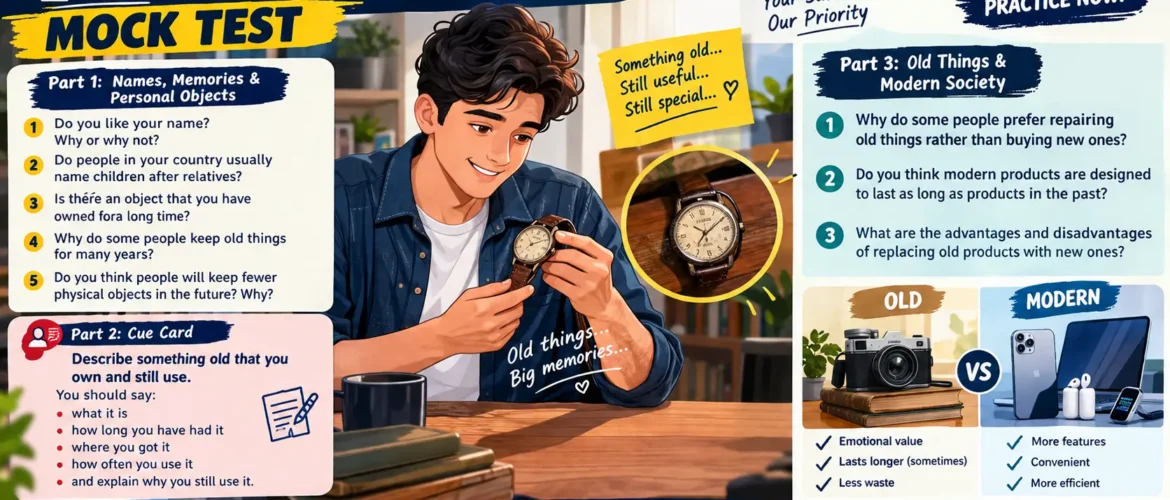
IELTS SPEAKING MOCK TEST 04.09.2026 Names, Memories & Personal Objects Describe something old that you own and still use Old Things & Modern Society
Manchester English Academy Bangladesh
IELTS SPEAKING MOCK TEST 04.09.2026 Names, Memories & Personal Objects Describe something old that you own and still use Old Things & Modern Society
🎤 IELTS Speaking — NEW Full Mock Test
⏱️ 11–15 Minutes | Part 1 + Part 2 + Part 3
🟢 PART 1 — Names, Memories & Personal Objects
- Do you like your name? Why or why not?
- Do people in your country usually name children after relatives?
- Is there an object that you have owned for a long time?
- Why do some people keep old things for many years?
- Do you think people will keep fewer physical objects in the future? Why?
🟡 PART 2 — Cue Card
Describe something old that you own and still use.
You should say:
- what it is
- how long you have had it
- where you got it
- how often you use it
- and explain why you still use it
🎙️ Examiner
“You have one minute to prepare your answer. You may make some notes if you wish.”
After one minute:
“Alright, you can start speaking now.”
⏱️ Target: 1:30–2:00 minutes
🔴 PART 3 — Old Things & Modern Society
- Why do some people prefer repairing old things rather than buying new ones?
- Do you think modern products are designed to last as long as products in the past?
- What are the advantages and disadvantages of replacing old products with new ones?
🎯 Examiner Focus
Part 1
Answer → Reason → Small example
Part 2
Identify → Background → Description → Personal experience → Why important → Feeling
Part 3
Opinion → Reason → Explanation → Example → Consequence
Important: Don’t memorise complicated vocabulary. Aim for natural fluency, precise vocabulary, grammatical variety, clear pronunciation, and fully developed ideas.
Absolutely. Here are Band 9 model answers for the latest mock test on Names, Memories & Old Things.
PART 1 — Names, Memories & Personal Objects
1. Do you like your name? Why or why not?
Band 9 Answer:
Yes, I do. I’ve always felt that my name suits me quite well because it has a pleasant sound and carries a sense of identity for me. More importantly, I’ve become emotionally attached to it over the years because it’s the name my family chose for me. So, even though I’ve never given it much thought, I certainly wouldn’t want to change it.
🎯 Tip:
Use Answer → Reason → Personal feeling. Avoid simply saying “Yes, I like it because it is nice.”
2. Do people in your country usually name children after relatives?
Band 9 Answer:
Yes, to some extent. In many families, especially traditional ones, children are given the names of grandparents or other respected relatives as a way of preserving family traditions. However, this practice seems to be becoming less common among younger parents, who often prefer distinctive or modern names. So, I’d say both traditions and personal preferences influence the choice of names nowadays.
🎯 Tip:
For questions about society, use:
General trend → Traditional practice → Modern change → Conclusion
3. Is there an object that you have owned for a long time?
Band 9 Answer:
Yes. I have an old wristwatch that I’ve owned for more than a decade. It was given to me by a family member, so it has considerable sentimental value. Although I have newer watches and could easily replace it, I still keep it and occasionally wear it because it reminds me of an important period in my life.
🎯 Tip:
Give one specific object and immediately explain its emotional value.
4. Why do some people keep old things for many years?
Band 9 Answer:
I think sentimental attachment is probably the main reason. People often associate old possessions with particular people, places, or periods of their lives, so getting rid of them can feel like throwing away a piece of their personal history. In addition, some old objects may have practical or financial value, especially if they are rare or well preserved.
🎯 Tip:
Give 2 reasons:
sentimental value + practical/financial value.
5. Do you think people will keep fewer physical objects in the future? Why?
Band 9 Answer:
Yes, I think that’s quite likely. As technology becomes increasingly digital, people are relying less on physical items such as books, photographs, documents, and even music collections. For example, someone can now store thousands of photos and books on a single device. That said, I don’t think physical possessions will disappear completely because people will probably continue to value objects that have emotional or cultural significance.
🎯 Tip:
Use prediction + reason + example + balanced exception.
This makes a short Part 1 answer sound mature without becoming too long.
PART 2 — CUE CARD
Describe something old that you own and still use.
You should say:
- what it is
- how long you have had it
- where you got it
- how often you use it
- and explain why you still use it
⭐ Band 9 Model Answer
One old possession that I still use regularly is a wristwatch that was given to me by a close family member. I’ve had it for more than ten years, so by any standard, it’s quite an old item.
I received it when I was going through an important stage of my life. At the time, it wasn’t particularly expensive or luxurious, but I remember being extremely happy to receive it because of the person who gave it to me. The watch has a simple design, with a traditional leather strap and a fairly classic appearance. Although it has developed a few minor scratches over the years, it still works perfectly well.
I don’t necessarily wear it every single day, because I sometimes use my phone to check the time, but I tend to wear it when I attend formal occasions, meetings, or important events. Interestingly, whenever I put it on, it reminds me of that particular period of my life and the person who gave it to me.
The main reason I’ve kept using it is its sentimental value. I could easily buy a newer and more sophisticated watch, but a new one wouldn’t have the same emotional significance. For me, this watch is more than just a device for telling the time; it represents a personal memory and a connection with someone important to me.
So, despite being quite old, I have no intention of getting rid of it. In fact, I hope to keep it for many more years and perhaps eventually pass it on to someone in my family.
🎯 Cue Card Structure
Remember this easy sequence:
IDENTIFY → HISTORY → DESCRIPTION → USE → REASON → FEELING → FUTURE
You can adapt this structure to almost any “old thing you own” cue card.
🔥 Useful Band 8/9 Vocabulary
- sentimental value → emotional importance
- a treasured possession → something you value highly
- a family heirloom → an object passed down through generations
- well-preserved → kept in good condition
- a personal connection → an emotional relationship with something
- remind me of → make me remember
- replace something → get rid of an old item and buy another
- stand the test of time → remain useful for a long period
- hold on to something → keep something rather than discard it
PART 3 — OLD THINGS & MODERN SOCIETY
1. Why do some people prefer repairing old things rather than buying new ones?
Band 9 Answer:
There are several reasons for this. First of all, repairing something is often considerably cheaper than replacing it, particularly when the original item is expensive or of good quality. Secondly, some people develop an emotional attachment to possessions that they have owned for many years. There is also an environmental argument because repairing products reduces waste and prevents perfectly usable items from ending up in landfills. So, for both financial and environmental reasons, repairing can be a sensible choice.
🎯 Tip:
For Why questions in Part 3:
Reason 1 → Explanation → Reason 2 → Explanation → Broader consequence
2. Do you think modern products are designed to last as long as products in the past?
Band 9 Answer:
Not necessarily. In some respects, modern products are technologically superior and may be more efficient and reliable than older ones. However, many modern consumer goods are produced with relatively short life cycles because manufacturers constantly introduce newer models. Consumers are also encouraged to replace their devices even when the existing ones still function properly. That said, there are certainly modern products, particularly high-quality appliances and specialist equipment, that can last for many years if they are properly maintained.
🎯 Tip:
This is a comparison question, so avoid an absolute “yes” or “no.” Use:
Past → Present → Reason → Exception
3. What are the advantages and disadvantages of replacing old products with new ones?
Band 9 Answer:
Replacing old products has both advantages and disadvantages. On the positive side, newer products are often more energy-efficient, technologically advanced, and convenient to use. For example, a modern smartphone can perform functions that would have required several separate devices in the past.
However, frequent replacement can be expensive and can contribute significantly to environmental problems. Manufacturing new products consumes raw materials and energy, while discarded electronics create enormous amounts of waste. Therefore, I think replacing something makes sense when the old product is genuinely inefficient or no longer functional, rather than simply because a newer version is available.
🎯 Tip:
For advantages/disadvantages, use:
Advantage → Example → Disadvantage → Example → Your balanced opinion
⭐ MASTER IELTS FORMULAS
Part 1
Direct Answer + Reason + Example/Detail
Yes, I do, mainly because… For example…
Part 2
Identify → Background → Description → Use → Reason → Feeling → Future
Part 3
Opinion → Reason → Explanation → Example → Consequence → Balanced conclusion
🚨 Band 9 Reminder
Don’t try to sound Band 9 by using difficult words in every sentence. A genuinely high-level answer should be:
Natural + Precise + Well-developed + Grammatically varied + Coherent
For example, “sentimental value” is much better than forcing an unusual synonym for “emotional importance.”
IELTS Speaking Mock Test Assessment — Mr. Nobel
Based on the transcript you provided, I would estimate the candidate at approximately Band 6.0 overall. The strongest area is his ability to keep speaking and develop ideas; the weakest area is Grammatical Range & Accuracy, followed by precision of vocabulary and logical control in Part 3.
Important: Pronunciation cannot be scored reliably from a transcript alone. If I had the audio, I could assess pronunciation, stress, intonation, connected speech, and individual sounds more accurately.
📊 Estimated Band Score
| Criterion | Estimated Band | Assessment |
| Fluency & Coherence | 6.0 | Can speak at length, but frequent reformulation, repetition and unclear connections affect coherence |
| Lexical Resource | 6.0 | Good attempt at idiomatic/less common vocabulary, but many words are used unnaturally |
| Grammatical Range & Accuracy | 5.0 | Frequent errors with tense, articles, plurals, sentence structure, pronouns and verb forms |
| Pronunciation | 6.0* | Provisional only; audio is required for a genuine score |
| Overall | 6.0 | A reasonable estimate from the transcript |
1. FLUENCY & COHERENCE — BAND 6.0
✅ Strengths
The candidate can:
- answer without completely stopping;
- develop answers beyond one or two sentences;
- provide personal examples;
- speak for a substantial amount of time in Part 2;
- use some linking expressions:
- Firstly
- On the other hand
- Besides
- For example
- Nowadays
- At that moment
The Part 2 response has a clear story:
father → watch → examination → achievement → emotional value → family legacy
That’s a good foundation.
❌ Problems
There is considerable repetition and self-correction.
For example:
“I liked her, his wrist watch…”
and:
“I don’t have the chance to watch that watch…”
The candidate also sometimes begins an idea without knowing exactly where the sentence is going.
For example:
“Over the course of my life, I have quite a lot of objects. But if I have to mention one, that I really like…”
A more natural opening would be:
“One old possession that immediately comes to mind is a wristwatch that my father gave me…”
🎯 How to improve
Don’t try to fill time by repeating the same idea.
Use:
Answer → Reason → Explanation → Example → Result
Especially in Part 3, every answer should have a clear logical progression.
2. LEXICAL RESOURCE — BAND 6.0
✅ Good vocabulary
The candidate attempted several higher-level expressions:
- legacy
- traditional
- cultural
- motivation
- precious moment
- fashionable
- rare
- extra effort
- over the moon
- cost an arm and a leg
- trustworthy
- betterment
This shows an attempt to move beyond basic vocabulary.
❌ Main problem: inappropriate collocations
The candidate knows many expressions but doesn’t always know how they naturally fit into a sentence.
For example:
“it’s a symbol of their traditional, cultural”
Better:
“It can represent their cultural traditions.”
“People loves to keep old things…”
Better:
“People love to keep old things…”
“go some extra mile to teach others how to like to store old things”
This is very unnatural.
Better:
“They may even make an effort to preserve these objects and pass them on to future generations.”
“new fashionable things are arriving”
Better:
“new products are constantly being introduced to the market.”
“lots of fake things are already in the market”
Better:
“There are many low-quality or counterfeit products on the market.”
🚨 Important Band 9 lesson
Don’t collect idioms just to use them.
For example, the candidate uses:
“cost an arm and a leg”
This is a real idiom, but it isn’t always necessary.
A Band 9 speaker could simply say:
“They can be extremely expensive.”
Precision > complicated vocabulary.
3. GRAMMATICAL RANGE & ACCURACY — BAND 5.0
This is the candidate’s biggest weakness.
There are frequent grammatical errors, although the meaning is usually understandable.
❌ Examples
Candidate:
“when I was born, this name was very special”
More natural:
“When I was born, my family chose this name because it was special to them.”
Candidate:
“And they believe with that way, they can able to connect each other.”
Better:
“They believe that this helps them maintain a connection with their relatives.”
Candidate:
“I have quite an object that I have owned for a long time.”
Better:
“I have an object that I’ve owned for a long time.”
Candidate:
“when I start at my university”
Better:
“when I started university”
Candidate:
“I give a lot of sacrifices for my university”
Better:
“I made a lot of sacrifices during my university years.”
Candidate:
“People loves to keep old things”
Better:
“People love to keep old things.”
Candidate:
“it will be the family legacy”
Better:
“It would become a family heirloom.”
Candidate:
“I have to give them a new product”
This doesn’t clearly answer the question.
Better:
“Replacing an old product allows people to benefit from newer technology and improved features.”
🎯 Grammar targets
The candidate should particularly practise:
- Subject–verb agreement
- People love, not people loves.
- Past tense
- I started, I received, my father gave me.
- Articles
- a wristwatch
- an object
- the watch
- Verb patterns
- “I was able to…”
- not “I can able to…”
- Natural collocations
- make sacrifices
- maintain relationships
- preserve traditions
- pass something down
- replace a product
4. PART 1 ASSESSMENT
Question 1: Do you like your name?
Candidate’s performance: 6.0
The answer contains a personal story and both positive and negative aspects, which is good.
However:
“when I was born, this name was very special”
and:
“the emotion of my life”
are unclear.
Better Band 9 Answer
Yes, I do. I’ve always liked my name because it has a special meaning in my family. When I was born, one of my uncles suggested it and considered it a symbol of affection. So, I’ve developed quite a strong emotional connection with it over the years. The only minor drawback is that it’s fairly common nowadays, so I sometimes meet several people with the same name.
PART 1 — Question 2
Candidate: 6.0
The candidate correctly identifies naming children after relatives as a tradition.
But:
“they can able to connect each other”
is grammatically incorrect.
Band 9 Answer
Yes, quite often. It’s a fairly common tradition in my country, particularly among older generations. Parents sometimes name their children after grandparents or other respected relatives as a way of honouring them and maintaining a connection between generations. Although younger parents are increasingly choosing more modern or unusual names, the tradition is still quite strong.
PART 1 — Question 3
Candidate: 5.5
There was an initial misunderstanding, which the candidate eventually corrected.
The important thing is that he recovered and gave a relevant answer:
“I have a wrist watch that I have owned for a long time…”
That’s good recovery.
Band 9 Answer
Yes, I do. I have an old wristwatch that I’ve owned since I was about fifteen. My father gave it to me after I did particularly well in my final examination, so it has enormous sentimental value. Even though I have newer watches, I still keep this one because it reminds me of my childhood and my father’s encouragement.
PART 1 — Question 4
Candidate: 6.0
Good attempt to discuss:
- tradition
- culture
- family
- future generations
But the ideas aren’t expressed naturally.
Band 9 Answer
I think sentimental value is the main reason. People often associate old possessions with important memories, family members or particular stages of their lives. Some objects may also have cultural or historical significance, so people want to preserve them and eventually pass them down to younger generations.
PART 1 — Question 5
Candidate: 5.5
The candidate tries to give a balanced answer, but the logic becomes unclear.
“If people loves to buy things regularly, they usually like to keep things rarely.”
This doesn’t clearly express the intended idea.
Band 9 Answer
Yes, probably. As more aspects of our lives become digital, people may have less need for physical possessions. For instance, books, photographs, music and documents can all be stored digitally nowadays. However, I don’t think physical objects will disappear completely because people will still want to keep possessions that have sentimental or cultural value.
⭐ PART 2 ASSESSMENT
Candidate’s Part 2: Band 6.0–6.5
This was actually one of the candidate’s stronger performances.
What he did well
He included:
✅ What the object was
✅ How old it was
✅ Who gave it to him
✅ Why it was special
✅ A story about his examination
✅ His father’s role
✅ Emotional significance
✅ Future family legacy
The story about his father promising the watch if he performed well in his examination was a very good idea.
The strongest section was essentially:
His father promised him the watch if he performed well → he worked harder → he came first in the examination → his father gave him the watch.
That is exactly the kind of personal narrative that makes a cue-card answer engaging.
Main problems
1. Grammar
“I have received that wrist watch”
Better:
“I received that wristwatch.”
2. Wrong word
“I liked her, his wrist watch…”
This creates confusion.
Better:
“I really liked the watch because…”
3. Repetition
The word watch appears excessively.
Use:
- possession
- timepiece
- wristwatch
- item
- gift
- keepsake
- family heirloom
But don’t force these words.
4. One important task was not fully answered
The cue card asked:
how often you use it
The candidate doesn’t give a clear frequency.
He says:
“when I have some time…”
That’s vague.
A better answer:
“I don’t wear it every day, but I usually wear it on special occasions or when I attend family events.”
⭐ BAND 9 PART 2 MODEL ANSWER
One old possession that immediately comes to mind is a wristwatch that my father gave me when I was about fifteen years old. I’ve had it for well over a decade, and although I’ve owned many watches since then, this particular one remains extremely special to me.
My father bought it while he was travelling in the United States. At that time, it was quite an unusual and fashionable watch, and I was fascinated by it as soon as I saw it. I remember asking him if I could have it, but he made me a deal. He told me that I could have the watch if I performed exceptionally well in my final examination. That really motivated me to work harder, and, fortunately, I came first in the examination that year.
As a result, my father kept his promise and gave me the watch. I was absolutely over the moon because it wasn’t simply an expensive gift; it represented my achievement and my father’s encouragement.
I don’t wear it every day nowadays because I usually rely on my phone to check the time, but I still wear it occasionally, particularly on special occasions or when I’m spending time with my family.
The main reason I still keep it is its sentimental value. Every time I wear it, I’m reminded of my father, my school days and the effort I made to achieve something important. In fact, my father once told me that it could eventually become a family heirloom, and I’d love to preserve it and pass it on to the next generation.
So, for me, it’s much more than a wristwatch. It’s a reminder of my father’s love, my own achievement and a very important chapter of my life.
🔥 Why this is Band 9 style
It has:
Object → Background → Story → Specific details → Frequency → Emotional value → Future
And importantly, it doesn’t depend on difficult vocabulary. The answer sounds natural and personal.
PART 3 ASSESSMENT
This is where the candidate needs the most improvement.
Question 1
Why do some people prefer repairing old things rather than buying new ones?
Candidate: 5.5–6.0
He gives relevant reasons:
- family legacy
- emotional value
- new products are expensive
But the answer moves away from the actual question.
The strongest point should have been:
Repairing → cheaper → sentimental value → environmentally friendly
Band 9 Answer
I think there are several reasons for this. First, repairing something is usually cheaper than replacing it, especially if the original product is expensive or still in reasonably good condition. Secondly, people can become emotionally attached to possessions they’ve owned for many years, particularly if those items were gifts from family members. Finally, repairing things is more environmentally friendly because it reduces waste. So, people may repair old products for financial, emotional and environmental reasons.
PART 3 — Question 2
Do you think modern products are designed to last as long as products in the past?
Candidate: 5.5
The candidate understands the general comparison but doesn’t develop it logically.
He says:
“lots of fashionable things are arising, which is not properly equipped.”
This is unclear.
He needs a clear past vs present comparison.
Band 9 Answer
Not necessarily. I think it depends on the type and quality of the product. Some modern products are actually more durable and technologically advanced than older ones, but many consumer goods are designed with relatively short life cycles. Manufacturers frequently release newer models, and consumers are encouraged to replace their products rather than repair them. In contrast, some older products were built to be extremely durable and repairable. So, while modern technology is often superior, that doesn’t necessarily mean modern products are built to last longer.
PART 3 — Question 3
What are the advantages and disadvantages of replacing old products with new ones?
Candidate: 5.0–5.5
This is the weakest Part 3 answer.
The biggest issue is that the candidate doesn’t directly answer the advantages of replacing old products.
He mainly talks about the price of old and new products.
The answer should have been:
Advantages
- better technology
- improved efficiency
- better safety
- more convenient features
Disadvantages
- expensive
- creates waste
- environmental impact
- unnecessary consumerism
Band 9 Answer
There are clear advantages and disadvantages. On the positive side, replacing an old product can give people access to better technology, improved efficiency and additional features. For example, a modern smartphone can perform many functions that previously required several different devices.
However, there are also significant drawbacks. New products can be expensive, and constantly replacing perfectly functional items contributes to environmental problems because it creates more waste and requires additional raw materials. In my opinion, people should replace an old product when it is genuinely inefficient, unsafe or beyond repair, rather than simply because a newer model is available.
🚨 TOP 10 MISTAKES MR. NOBEL SHOULD FIX
| Candidate’s version | Better version |
| People loves | People love |
| I can able to | I can / I am able to |
| I give sacrifices | I make sacrifices |
| connect each other | connect with each other |
| an object that I have it | an object that I have |
| when I start university | when I started university |
| one of the main part | one of the main parts |
| new things are arising | new things are being introduced |
| in the market | on the market |
| watch → watch that watch | watch → wear/use that timepiece |
🎯 MR. NOBEL’S PERSONAL IMPROVEMENT FORMULA
The candidate does not need more complicated vocabulary first.
He needs to improve sentence accuracy + logical development.
Step 1 — Stop translating directly from Bangla
Instead of:
“They can able to connect each other.”
Think:
“This helps them maintain a connection.”
Step 2 — Use shorter grammatical sentences
Don’t try to create extremely long sentences if grammar breaks down.
Instead of:
“People believe it’s a legacy of their family and they also believe old things makes people more expressive…”
Say:
“Some old possessions become family heirlooms. People value them because they have emotional significance.”
Simple + accurate > long + inaccurate.
Step 3 — Part 3 = PREP
For every Part 3 question:
P — Point
R — Reason
E — Explanation
P — Personal/Social example
Example:
I think repairing old products is better in some situations.
The main reason is that it’s usually cheaper.
People can continue using something they already own instead of spending money on a replacement.
For example, repairing an old washing machine may cost far less than buying a new one.
That is much more powerful than trying to insert idioms.
🏆 FINAL VERDICT
Estimated overall: Band 6.0
The candidate has good potential to reach 6.5–7.0, because he already has some important strengths:
✅ Can speak at length
✅ Has personal experiences to discuss
✅ Can tell a story
✅ Attempts advanced vocabulary
✅ Can give reasons and examples
✅ Can maintain interaction with the examiner
But he currently loses marks because of:
❌ Frequent grammatical errors
❌ Incorrect collocations
❌ Repetition
❌ Unclear sentence construction
❌ Weak Part 3 development
❌ Occasional misunderstanding of the question
❌ Overuse/misuse of idioms
❌ Insufficiently precise answers
The most important advice:
Don’t try to sound more sophisticated. Try to sound more accurate.
If Mr. Nobel can reduce his grammatical errors while keeping his current ability to speak at length, Band 6.5 is a realistic next target, and with stronger Part 3 development and consistently accurate complex sentences, Band 7+ becomes achievable.
💐 Thanks, and Good Luck! 🤞
———————————————————————————————————————
🖋 Krishna Kumar Sharma Founder & Mentor of Manchester English Academy Bangladesh
“Krishna Kumar Sharma is a specialist English teacher and mentor with more than 15 years of real-life and online teaching experience. He studied Business Management in Manchester, United Kingdom; Hotel Management in Kuala Lumpur, Malaysia; and Plant Science at Jagannath University, Dhaka, Bangladesh. He has been teaching and mentoring English to children and adults across various levels, ensuring that each achieves their respective goals. Preparing students for IELTS and viva exams is a passion for him, as he prides himself on helping students pass their exams and achieve their desired scores. Krishna Kumar Sharma is patient and determined to produce significant results for his students. He helps busy, motivated English learners become bolder, braver, and more confident English speakers. So, if you want to enhance your English, join us for a better future!”
For Admission Call: +8801719454538 & +8801773744422 (WhatsApp) ইংরেজিতে প্রতিদিন গুরুত্বপূর্ণ ভিডিও পেতে আমাদের পেজ ফলো করে রাখুন। (To get important videos in English Topics please follow our social media sites)
► Website: https://manchesterenglishacademy.com/ ► Youtube: https://www.youtube.com/@ManchesterEnglishAcademyBD ► English with Krishno Da (কৃষ্ণদার ইংলিশ স্কুল): https://www.youtube.com/@EnglishwithKrishnoDa
► Google Map: https://bit.ly/3V9YU5X ► Facebook: https://www.facebook.com/ManchesterEnglishAcademyBangladesh/ ► Krishna Da: https://www.facebook.com/KrishnaSirManchesterEnglishAcademyBangladesh/
► Twitter: https://twitter.com/ManchesterEngAB ► Tiktok: https://www.tiktok.com/@manchesterenglishacademy ► Instagram: https://www.instagram.com/manchester_english_academy_bd/